Introduction to Silica in Industrial Water Treatment
Silica (SiO₂) is a naturally occurring compound found in almost all water sources, including groundwater, surface water, borewell water, and municipal supplies. In industrial RO plants, silica is commonly present in dissolved or colloidal form. While silica itself is not harmful in small concentrations, it becomes a serious operational issue when its concentration exceeds solubility limits within the RO system.
Understanding silica fouling in industrial RO plants begins with recognizing how silica behaves under different chemical and physical conditions. As water passes through RO membranes, dissolved salts and impurities are rejected, concentrating in the reject stream. This concentration effect can push silica levels beyond their saturation limit, leading to precipitation and scale formation.
Forms of Silica in Feed Water
Silica exists in several forms, and identifying the form present in feed water is essential for selecting the right treatment approach.
Reactive (Dissolved) Silica
Reactive silica is present as monomeric silicic acid in water. It remains dissolved under normal conditions but can polymerize when concentration, pH, or temperature increases. In industrial RO plants, reactive silica becomes problematic when high recovery rates cause concentration buildup.
Colloidal Silica
Colloidal silica consists of extremely fine suspended particles that do not dissolve but remain dispersed in water. These particles are difficult to remove through conventional filtration and can accumulate on membrane surfaces, causing fouling.
Polymerized Silica
When dissolved silica molecules combine, they form polymerized silica. This form contributes to hard, dense scale deposits that strongly adhere to RO membranes.
Understanding silica fouling in industrial RO plants requires distinguishing between these forms because each type requires different control methods.
How Silica Fouling Occurs in Industrial RO Plants
Silica fouling develops gradually and often goes unnoticed until performance declines significantly. The process typically follows these stages:
-
Concentration of silica in the reject stream.
-
Exceeding silica solubility limit.
-
Polymerization of dissolved silica.
-
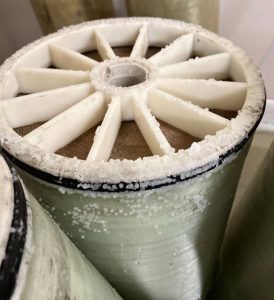
Formation of scale on membrane surface.
-
Reduced permeate flow and increased pressure.
Unlike calcium carbonate or sulfate scaling, silica scale forms a glass-like, non-porous layer that is extremely difficult to remove. Once formed, it acts as a barrier, restricting water flow and increasing system resistance.
Understanding silica fouling in industrial RO plants helps operators detect early warning signs before irreversible damage occurs.
Factors Contributing to Silica Fouling
Several operational and environmental factors influence silica scaling in industrial RO systems.
High Recovery Rates
Higher recovery means more water is converted into permeate, concentrating rejected salts and silica in the remaining water. Excessive recovery increases scaling risk.
Elevated pH
Silica solubility changes with pH. At higher pH levels, silica tends to polymerize more rapidly.
Temperature
Higher operating temperatures accelerate chemical reactions and increase scaling tendency.
Poor Pretreatment
Inadequate filtration allows colloidal silica and suspended solids to reach membranes.
Insufficient Antiscalant Dosing
Incorrect or low antiscalant dosage reduces the ability to control silica precipitation.
Inconsistent Feed Water Quality
Seasonal changes or borewell variations can increase silica levels unexpectedly.
Understanding silica fouling in industrial RO plants allows proper adjustment of these variables to minimize risk.
Industries Affected by Silica Fouling
Silica fouling is particularly problematic in industries requiring high-purity water, such as:
-
Power plants (boiler feed water)
-
Pharmaceutical manufacturing
-
Textile processing
-
Food and beverage production
-
Electronics and semiconductor manufacturing
-
Chemical industries
In these sectors, consistent water quality is critical. Silica contamination can affect final product quality and equipment efficiency.
Impact of Silica Fouling on RO System Performance
Understanding silica fouling in industrial RO plants helps explain its operational consequences:
Reduced Permeate Flow
Silica deposits block membrane pores, decreasing water production.
Increased Differential Pressure
Accumulated scale increases resistance across membrane elements.
Higher Energy Consumption
More pressure is required to maintain output, increasing electricity costs.
Reduced Salt Rejection
Scaling can damage membrane surface, affecting separation efficiency.
Shortened Membrane Life
Severe fouling often leads to premature membrane replacement.
Detection and Monitoring of Silica Fouling
Early detection is essential to prevent major system damage.
Key Monitoring Parameters:
-
Feed water silica concentration
-
Permeate flow rate
-
Differential pressure
-
Salt rejection rate
-
Recovery percentage
Regular laboratory testing and online monitoring systems help track silica levels. Performance trend analysis provides early warnings of fouling development.
Understanding silica fouling in industrial RO plants emphasizes proactive monitoring rather than reactive maintenance.
Prevention Strategies for Silica Fouling
Preventive control is the most cost-effective approach.
Feed Water Analysis
Routine testing determines silica concentration and scaling potential.
Optimized Pretreatment Systems
-
Multimedia filters
-
Activated carbon filters
-
Ultrafiltration (UF)
-
Coagulation-flocculation for colloidal silica
Proper Antiscalant Selection
Specialized RO antiscalants designed for silica control inhibit polymerization and crystal growth. Selecting high-quality antiscalants ensures effective protection even at higher silica levels.
pH Adjustment
Maintaining optimal pH improves silica solubility management.
Recovery Rate Optimization
Operating within manufacturer-recommended recovery limits prevents over-concentration.
Understanding silica fouling in industrial RO plants ensures proper design and operation strategies.
Role of RO Antiscalants in Silica Control
RO antiscalants play a critical role in controlling silica fouling. They work by:
-
Interfering with silica polymerization
-
Preventing particle agglomeration
-
Keeping silica dispersed
-
Allowing higher recovery rates without scaling
Selecting the right dosage and product formulation is essential for effective performance. Incorrect dosing may lead to inadequate protection or unnecessary chemical costs.
Cleaning Silica Fouled Membranes
Once silica scaling occurs, cleaning becomes challenging.
Cleaning Methods Include:
-
High pH alkaline cleaning solutions
-
Specialized silica removal chemicals
-
Elevated temperature cleaning (within manufacturer limits)
-
Multiple cleaning cycles
Even with proper cleaning, complete removal may not always be possible. Severe scaling often requires membrane replacement.
Understanding silica fouling in industrial RO plants highlights the importance of prevention over corrective action.
Economic Impact of Silica Fouling
Silica fouling directly affects operational expenses:
-
Increased energy bills
-
Higher chemical consumption
-
Frequent cleaning cycles
-
Downtime losses
-
Membrane replacement costs
For large industrial RO plants, these costs can be significant. Preventive maintenance is far more economical than emergency repairs.
Best Practices for Long-Term Silica Control
To ensure consistent system performance:
-
Conduct daily system performance checks
-
Maintain proper antiscalant dosing pumps
-
Monitor seasonal changes in feed water
-
Schedule preventive membrane cleaning
-
Train operators on scaling risks
-
Use performance projection software
Understanding silica fouling in industrial RO plants supports sustainable water treatment management.
Future Trends in Silica Management
Advancements in water treatment technologies are improving silica control:
-
High-rejection RO membranes
-
Improved antiscalant formulations
-
Advanced online monitoring systems
-
Hybrid systems combining RO and EDI
-
Enhanced pretreatment methods
Industries investing in advanced silica control technologies benefit from improved operational stability and reduced downtime.
Conclusion
Understanding silica fouling in industrial RO plants is essential for maintaining efficiency, reducing operational costs, and extending membrane life. Silica scaling is one of the most challenging problems in industrial water treatment due to its hard, glass-like nature and resistance to conventional cleaning methods. However, with proper feed water analysis, optimized operating conditions, effective pretreatment, and high-performance RO antiscalants, industries can successfully manage silica fouling.
A proactive and well-monitored approach ensures consistent water quality, improved productivity, and long-term reliability of industrial RO systems. By prioritizing understanding silica fouling in industrial RO plants, organizations can protect their investment, enhance system performance, and achieve sustainable water treatment operations.