Introduction
Uses of sand filter and carbon filter in ro plant. Reverse Osmosis (RO) plants are widely used for producing high-quality water for drinking, industrial processes, pharmaceuticals, food & beverage, power plants, and wastewater reuse. While the RO membrane is the heart of the system, its performance and life depend heavily on proper pretreatment.
Two of the most critical pretreatment units in an RO plant are:
- Sand Filter (Multigrade or Multimedia Filter)
- Carbon Filter (Activated Carbon Filter)
These filters protect RO membranes from fouling, scaling, oxidation, and premature failure. Without proper sand and carbon filtration, even the best RO membranes will suffer from reduced flux, increased pressure drop, frequent chemical cleaning, and shortened life.
This document explains in detail:
- What sand filters and carbon filters are
- Why they are required in RO plants
- Their construction and working principles
- Specific contaminants removed
- Benefits, limitations, and design considerations
- Differences between sand filter and carbon filter
- Their role in extending RO membrane life
Overview of Pretreatment in RO Plants
Raw water sources such as borewell, river, lake, municipal supply, or treated wastewater contain various contaminants. Uses of sand filter and carbon filter in ro plant
including:
- Suspended solids
- Turbidity
- Silt
- Organic matter
- Chlorine and chloramines
- Color, odor, and taste-causing compounds
- Iron and manganese
- Oil and grease (in some cases)
RO membranes are highly sensitive to these impurities. Even small amounts of suspended solids or oxidants can cause serious membrane damage.
Uses of sand filter and carbon filter in ro plant. Pretreatment acts as a protective barrier, ensuring that feed water quality meets membrane manufacturer guidelines. Sand filters and carbon filters are the first and second lines of defense in most RO plants.
Sand Filter itn RO Plan
What is a Sand Filter?
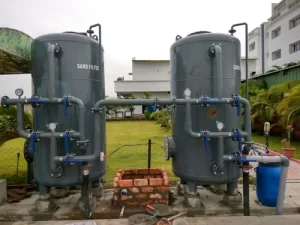
A sand filter is a mechanical filtration unit designed to remove suspended solids and turbidity from water by passing it through layers of graded media.
In RO plants, sand filters are commonly referred to as:
- Pressure Sand Filter (PSF)
- Multigrade Filter (MGF)
- Multimedia Filter (MMF)
Construction of Sand Filter
A typical sand filter consists of:
- Mild Steel (MS) or FRP pressure vessel
- Internal laterals or nozzles
- Graded filter media layers
- Inlet, outlet, backwash, and drain connections
- Manual or automatic valves
Filter Media Used in Sand Filter
Sand filters use multiple layers of media, arranged from coarse at the bottom to fine at the top:
- Gravel (support layer)
-
- Size: 6–40 mm
- Supports upper media and prevents nozzle blockage
- Coarse Sand
- Removes large suspended particles
- Fine Sand
- Removes smaller suspended solids and turbidity
- Anthracite (optional)
- Improves filtration efficiency
- Higher dirt-holding capacity
This graded arrangement ensures effective filtration throughout the bed depth.
Working Principle of Sand Filter
Uses of sand filter and carbon filter in ro plant. Water enters the sand filter from the top and flows downward through the media bed.
During this process:
- Suspended solids get trapped between media particles
- Larger particles are retained near the top
- Smaller particles penetrate deeper and get captured
- Clean water exits from the bottom through the underdrain system
As filtration continues, dirt accumulates and pressure drop increases. When pressure drop reaches a set limit, backwashing is required.
Backwashing of Sand Filter
Backwashing is essential for restoring filter performance.
Backwash Process
- Water flow is reversed (bottom to top)
- Media bed expands and loosens
- Trapped dirt is flushed out through the drain
- Filter bed re-settles after backwash
Importance of Backwashing
- Maintains low pressure drop
- Prevents channeling
- Ensures consistent filtration efficiency
- Extends media life
In RO plants, sand filters are typically backwashed once daily or when differential pressure increases by 0.6–1.0 kg/cm².
Uses of Sand Filter in RO Plant
Removal of Suspended Solids
Sand filters effectively remove:
- Mud
- Clay
- Silt
- Sand particles
- Rust particles
This reduces turbidity to acceptable levels for downstream treatment.
Reduction of Turbidity
High turbidity causes:
- Membrane fouling
- SDI increase
- Frequent membrane cleaning
Sand filters typically reduce turbidity to <5 NTU, which is suitable for further treatment.
Protection of RO Membranes
Suspended solids cause:
- Surface fouling
- Increased pressure drop
- Reduced permeate flow
By removing these solids, sand filters protect RO membranes and maintain system efficiency.
Reduction of Silt Density Index (SDI)
RO membranes require SDI values below 3–5.
Sand filters significantly reduce SDI by removing particulate matter that contributes to membrane fouling.
Removal of Iron and Manganese (Partially)
Uses of sand filter and carbon filter in ro plant. Oxidized iron and manganese particles are effectively removed by sand filters, especially when combined with aeration or chemical oxidation.
Essential Pretreatment for Carbon Filter
Carbon filters are sensitive to fouling. Sand filters prevent carbon bed clogging by removing solids before water reaches the carbon filter.
Advantages of Sand Filter
- Simple and robust design
- Low operating cost
- Handles high turbidity water
- Easy operation and maintenance
- Long media life
- Essential for raw water pretreatment
Limitations of Sand Filter
- Does not remove dissolved contaminants
- Ineffective against chlorine and organics
- Requires regular backwashing
- Not suitable as standalone pretreatment for RO
Therefore, sand filters are always followed by carbon filters or other advanced pretreatment units. Uses of sand filter and carbon filter in ro plant
Carbon Filter in RO Plant
What is a Carbon Filter?
A carbon filter uses activated carbon to remove:
- Chlorine
- Chloramines
- Organic compounds
- Color
- Odor
- Taste-causing substances
In Uses of sand filter and carbon filter in ro plant, carbon filters are mainly used to protect membranes from oxidants.
Activated Carbon Used in RO Plants
Activated carbon is produced from:
- Coconut shell (most common in India)
- Coal
- Wood
Properties of Activated Carbon
- Very high surface area (800–1200 m²/g)
- Highly porous structure
- Strong adsorption capacity
Coconut shell activated carbon is preferred due to:
- Higher hardness
- Lower ash content
- Better chlorine removal efficiency
Construction of Carbon Filter
A carbon filter consists of:
- MS or FRP pressure vessel
- Internal distribution and collection system
- Activated carbon media
- Supporting gravel layers
- Backwash and drain connections
Design is similar to a sand filter but with different media and operating parameters.
Working Principle of Carbon Filter
Water passes through the activated carbon bed, where contaminants are removed by adsorption.
Adsorption occurs when:
- Chlorine molecules attach to carbon surface
- Organic compounds bind to pores
- Odor and taste compounds get trapped
Unlike sand filters, carbon filters work through chemical and physical attraction, not just mechanical filtration.
Uses of Carbon Filter in RO Plant
Removal of Free Chlorine
Uses of sand filter and carbon filter in ro plant. Chlorine is commonly present in municipal water supplies.
Effects of chlorine on RO membranes:
- Oxidative damage
- Permanent membrane failure
- Loss of salt rejection
Carbon filters reduce chlorine to <0.1 ppm, making water safe for membranes. Uses of sand filter and carbon filter in ro plant.
Removal of Chloramines
Some water supplies use chloramines instead of chlorine.
Carbon filters:
- Break chloramine bonds
- Remove both chlorine and ammonia components
- Protect thin-film composite (TFC) membranes
Removal of Organic Matter
Organic compounds cause:
- Biofouling
- Increased microbial growth
- Membrane plugging
Carbon filters adsorb:
- Natural organic matter (NOM)
- Humic and fulvic acids
- Industrial organics
Improvement of Water Taste and Odor
Carbon filters remove:
- Phenols
- Sulfur compounds
- Volatile organic compounds (VOCs)
This is especially important for drinking water RO plants.
Protection of RO Membranes from Oxidation
Uses of sand filter and carbon filter in ro plant. RO membranes are extremely sensitive to oxidants.
Carbon filters act as a safety barrier before RO, preventing irreversible membrane damage.
Backwashing of Carbon Filter
Carbon filters also require periodic backwashing to:
- Remove trapped solids
- Reclassify carbon bed
- Prevent channeling
However, excessive backwashing should be avoided to prevent carbon loss.
Advantages of Carbon Filter
- Highly effective chlorine removal
- Improves overall water quality
- Protects expensive RO membranes
- Enhances taste and odor
- Long service life when properly maintained
Limitations of Carbon Filter
- Can support bacterial growth if not disinfected
- Requires regular monitoring of chlorine breakthrough
- Higher cost compared to sand media
- Not effective against dissolved salts
Difference Between Sand Filter and Carbon Filter
| Parameter | Sand Filter | Carbon Filter |
| Main Function | Suspended solids removal | Chlorine & organics removal |
| Filtration Type | Mechanical | Adsorption |
| Media | Sand, gravel, anthracite | Activated carbon |
| Removes Chlorine | No | Yes |
| Protects Membrane from Solids | Yes | Partially |
| Protects from Oxidants | No | Yes |
Importance of Using Both Filters in RO Plant
Using only one filter is insufficient.
- Sand filter protects carbon filter from fouling
- Carbon filter protects RO membrane from oxidation
- Together they ensure stable RO operation
- Reduce membrane cleaning frequency
- Extend membrane life significantly
Conclusion
Uses of sand filter and carbon filter in ro plant. Sand filters and carbon filters are essential components of any well-designed RO plant. While sand filters remove suspended solids and turbidity, carbon filters remove chlorine, chloramines, and organic contaminants.
Their combined role ensures:
- Stable RO performance
- Longer membrane life
- Lower operating costs
- Improved water quality
Ignoring or undersizing these filters often leads to frequent membrane failures, higher chemical consumption, and increased downtime. Therefore, proper selection, operation, and maintenance of sand and carbon filters are critical for the long-term success of any RO plant. Uses of sand filter and carbon filter in ro plant.