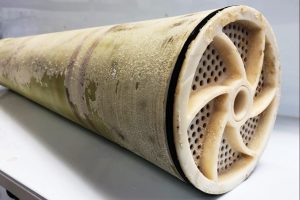
Why barium sulfate scale Is difficult to control in RO. Reverse Osmosis (RO) systems are widely used in industrial water treatment to remove dissolved salts, hardness, heavy metals, and contaminants. However, scaling remains one of the biggest operational challenges, especially when dealing with barium sulfate (BaSO₄) scale.
Among all inorganic scales, barium sulfate is one of the most difficult to control, prevent, and remove in RO systems. Even small concentrations of barium and sulfate ions can cause severe fouling, leading to membrane damage, reduced recovery, frequent CIP, and increased operating costs. Why barium sulfate scale Is difficult to control in RO.
Why barium sulfate scale Is difficult to control in RO. This article explains why barium sulfate scale is so problematic in RO, how it forms, why conventional control methods fail, and what advanced strategies are required to manage it effectively.
Understanding Scale Formation in RO Systems
What Is Scale in RO?
Why barium sulfate scale Is difficult to control in RO. Scale is a hard, crystalline deposit formed when sparingly soluble salts exceed their solubility limits and precipitate on RO membrane surfaces.
Common RO scales include:
-
Calcium carbonate (CaCO₃)
-
Calcium sulfate (CaSO₄)
-
Barium sulfate (BaSO₄)
-
Strontium sulfate (SrSO₄)
-
Silica scale
Among these, barium sulfate is the most stubborn and least soluble.
What Is Barium Sulfate Scale?
Chemical Nature of Barium Sulfate
Barium sulfate (BaSO₄) forms when:
-
Barium ions (Ba²⁺) react with
-
Sulfate ions (SO₄²⁻)
It is characterized by:
-
Extremely low solubility
-
High crystal hardness
-
Strong adhesion to membrane surfaces
The solubility product (Ksp) of barium sulfate is approximately: 1.1 × 10⁻¹⁰
Why barium sulfate scale Is difficult to control in RO. This is much lower than calcium sulfate or calcium carbonate, making BaSO₄ highly prone to precipitation even at trace concentrations.
Why Barium Sulfate Scale Is Especially Difficult to Control
Extremely Low Solubility
Why barium sulfate scale Is difficult to control in RO. Barium sulfate has one of the lowest solubilities of all common RO scales.
-
It can precipitate at ppm or even ppb levels
-
Slight increases in concentration can trigger instant scaling
-
Once formed, it does not easily re-dissolve
Even aggressive operating adjustments often fail to prevent precipitation.
High Supersaturation Tendency in RO
RO systems naturally concentrate dissolved salts:
-
As water passes through the membrane, salts remain in the reject stream
-
Recovery increases → concentration increases
-
Supersaturation occurs rapidly near the membrane surface
Why barium sulfate scale Is difficult to control in RO. Because barium sulfate has such a narrow solubility window, RO concentration polarization easily pushes it beyond its solubility limit.
Strong Crystal Structure and Adhesion
Barium sulfate forms:
-
Dense, crystalline deposits
-
Hard scale layers tightly bound to membrane surfaces
Unlike calcium carbonate, BaSO₄ does not form soft or porous scale that can be flushed away.
Once it attaches to the membrane:
-
Water permeability drops sharply
-
Differential pressure increases
-
Salt rejection declines
Poor Response to Conventional Antiscalants
Many standard antiscalants are designed primarily for:
-
Calcium carbonate
-
Calcium sulfate
-
Mild silica
However:
-
Barium sulfate crystals are difficult to distort
-
Conventional threshold inhibition often fails
-
Crystal growth inhibition requires specialized chemistry
As a result, wrong antiscalant selection is one of the biggest causes of BaSO₄ fouling. Why barium sulfate scale Is difficult to control in RO
Ineffective Cleaning (CIP) Options
Why barium sulfate scale Is difficult to control in RO. One of the biggest challenges is removal after formation.
-
Barium sulfate is acid-resistant
-
Standard acidic CIP (citric acid, HCl) is largely ineffective
-
Alkaline cleaning also fails
Once severe BaSO₄ scaling occurs, membranes may become permanently damaged, requiring replacement.
Sources of Barium in Feed Water
Barium is often present at low levels, making it easy to overlook. Why barium sulfate scale Is difficult to control in RO.
Common Sources:
-
Groundwater
-
Oil & gas produced water
-
Mining effluents
-
Power plant makeup water
-
Textile & chemical industry wastewater
-
Seawater & brackish water
Even 0.05–0.5 mg/L of barium can become dangerous in high-recovery RO systems.
Role of Sulfate in Barium Sulfate Scaling
Sulfate is widely present in:
-
Industrial effluents
-
Textile dyeing wastewater
-
Chemical process water
-
Seawater and brackish water
When sulfate concentrations are high:
-
Even trace barium causes scale
-
Blending water sources can suddenly trigger scaling
-
Process changes increase risk
High sulfate + low barium is still a high-risk combination.
Impact of Barium Sulfate Scale on RO Performance
Rapid Flux Decline
BaSO₄ scale forms a dense layer, leading to:
-
Sharp drop in permeate flow
-
Increased energy consumption
-
Frequent operational instability
Increased Differential Pressure (ΔP)
As scale builds up:
-
Feed pressure increases
-
ΔP across stages rises
-
Pumps work harder
This increases:
-
Power costs
-
Mechanical stress on membranes
Reduced Membrane Life
Because BaSO₄ is difficult to clean:
-
Membranes age faster
-
Chemical cleaning becomes aggressive
-
Polyamide layers degrade
Membrane replacement costs rise significantly.
Frequent CIP & Downtime
Uncontrolled BaSO₄ scaling leads to:
-
Short CIP intervals
-
Reduced plant availability
-
Higher chemical and labor costs
Why Conventional Control Methods Often Fail
pH Adjustment Is Ineffective
Unlike calcium carbonate:
-
Barium sulfate solubility is not strongly pH-dependent
-
Lowering pH does not dissolve BaSO₄
-
Acid dosing provides little protection
Softening Does Not Remove Barium Effectively
Standard lime or sodium softeners:
-
Target calcium and magnesium
-
Do not efficiently remove barium
-
May leave enough Ba²⁺ to cause scaling
Incorrect Saturation Index Calculation
Many RO designs:
-
Ignore barium due to low concentration
-
Focus only on LSI or calcium sulfate SI
-
Underestimate scaling risk
Barium sulfate requires specific modeling and monitoring.
Advanced Strategies to Control Barium Sulfate Scale in RO
Specialized Antiscalants for BaSO₄
Only high-performance antiscalants designed for:
-
Barium sulfate
-
Strontium sulfate
-
High sulfate waters
These work by:
-
Threshold inhibition at very low concentrations
-
Crystal distortion
-
Preventing adhesion to membranes
Correct selection and dosage are critical. Why barium sulfate scale Is difficult to control in RO.
Accurate Water Analysis & Modeling
Always test:
-
Barium (Ba²⁺)
-
Strontium (Sr²⁺)
-
Sulfate (SO₄²⁻)
Use advanced RO projection software that:
-
Includes BaSO₄ saturation indices
-
Considers temperature and recovery
-
Accounts for concentration polarization
Recovery Optimization
High recovery increases scaling risk.
Strategies include:
-
Reducing single-pass recovery
-
Using two-pass RO
-
Optimizing staging configuration
Lower concentration = lower supersaturation.
Pretreatment Options
In high-risk cases:
-
Barium-selective ion exchange
-
Chemical precipitation (carefully controlled)
-
Blending low-sulfate water
Pretreatment is often cheaper than membrane replacement.
Continuous Monitoring
Monitor:
-
Differential pressure
-
Normalized permeate flow
-
Salt rejection trends
Early detection allows:
-
Dose adjustment
-
Recovery reduction
-
Avoiding irreversible scaling
Barium Sulfate vs Other RO Scales (Comparison)
| Scale Type | Solubility | Cleanability | Risk Level |
|---|---|---|---|
| CaCO₃ | Moderate | Easy | Medium |
| CaSO₄ | Low | Moderate | High |
| SrSO₄ | Very Low | Difficult | Very High |
| BaSO₄ | Extremely Low | Very Difficult | Critical |
Real-World Industrial Challenges in India
In India, BaSO₄ scaling is often seen in:
-
Textile RO plants
-
Power plant RO systems
-
Chemical industries
-
ZLD systems
-
Groundwater-based RO plants
Common issues:
-
Incomplete feed water analysis
-
Generic antiscalant usage
-
High recovery pressure
-
Delayed CIP response
Key Takeaways: Why Barium Sulfate Scale Is So Hard to Control
-
Extremely low solubility
-
Forms at very low concentrations
-
Strong, adherent crystal structure
-
Poor response to acids and CIP
-
Requires specialized antiscalants
-
Often underestimated in RO design
Why barium sulfate scale Is difficult to control in RO. Ignoring barium sulfate risks severe membrane fouling and high operating costs.
Final Conclusion
Why barium sulfate scale Is difficult to control in RO. Barium sulfate scale represents one of the most challenging scaling problems in RO systems. Unlike common scales, it forms easily, adheres strongly, and resists removal. Conventional control strategies are often ineffective, making prevention the only viable approach.
By combining:
-
Accurate water analysis
-
Proper system design
-
Specialized antiscalants
-
Controlled recovery
-
Proactive monitoring
Why barium sulfate scale Is difficult to control in RO. RO operators can successfully manage barium sulfate scaling and protect membrane performance.